
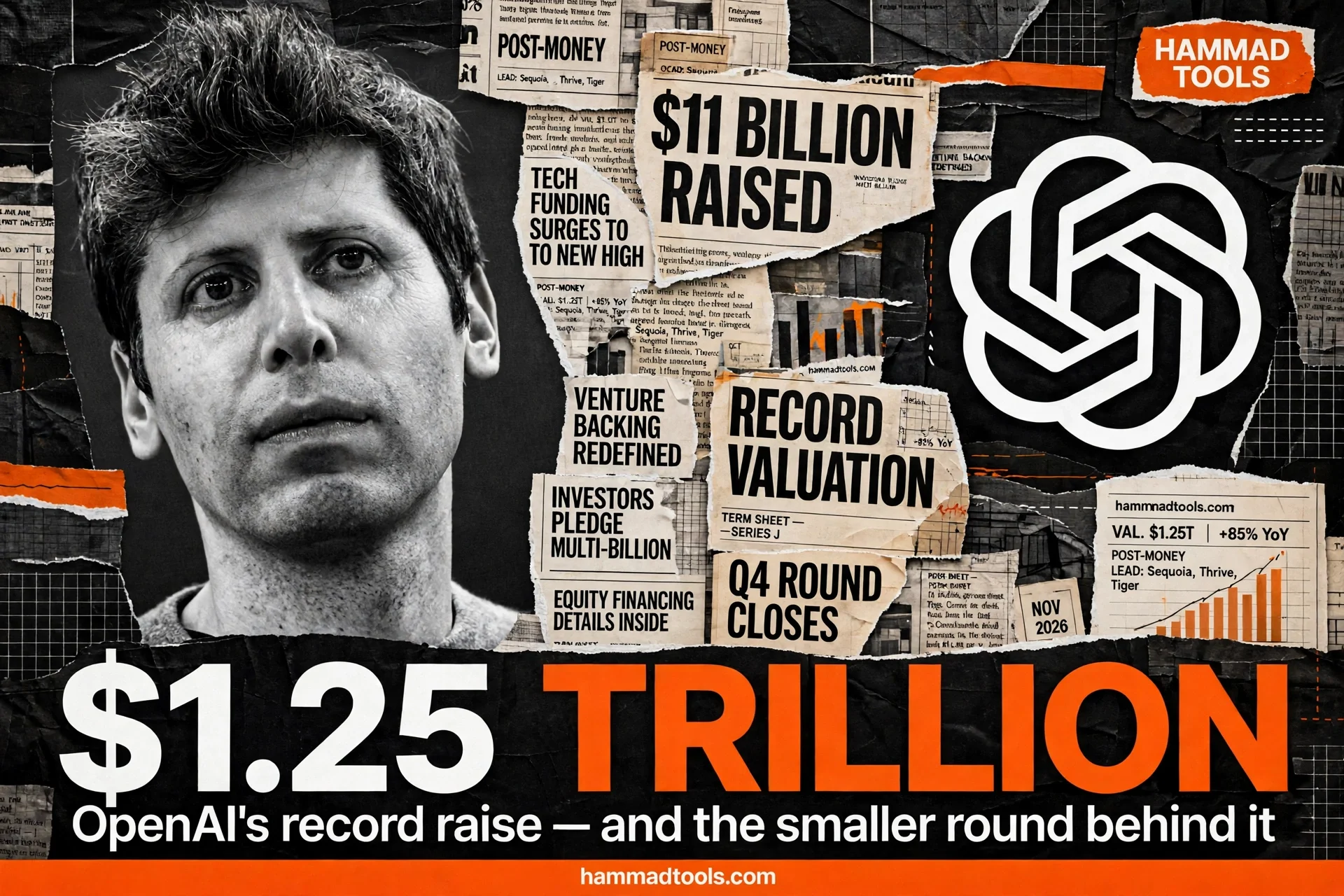
OpenAI is now, on paper, a $1.25 trillion company. That is the valuation attached to the $11 billion the ChatGPT maker has reportedly raised so far in a new funding round, according to Bloomberg on Friday 6 November. It would make OpenAI the most valuable private company in history — and yet the round is considerably smaller than the one OpenAI set out to raise.
The round has not closed. Bloomberg's sources say it is expected to wrap up in the coming weeks and could total about $20 billion. That is a serious sum by any measure. It is also, by OpenAI's own earlier ambitions, a comedown: in late September, Bloomberg reported the company was looking to raise $30 billion. The Financial Times later reported the target had been cut to around $20 billion, with the valuation sought lowered from $1.4 trillion to $1.25 trillion. OpenAI has not commented publicly, and TechCrunch says it has reached out for comment.
What Bloomberg actually reported
The reported facts are narrow. Eleven billion dollars has been raised so far. The valuation is $1.25 trillion. The round is still open, with roughly $20 billion as the expected total. Nothing here is confirmed by OpenAI itself, and until the round closes, both figures can still move.
That caution matters because OpenAI's valuation has a habit of being reported in two different ways. The company has only ever announced three valuations itself. Everything else — including the $500 billion figure that circulated through 2025 — comes from employee share sales reported in the press, not from new money going into the company. A share sale tells you what existing stock changed hands for; a funding round tells you what new investors will pay to buy in. The $1.25 trillion figure is the second kind: a price for new money, if the round closes as reported.
The valuation climb in four jumps
Put the new number against the confirmed arc and the scale of the climb is hard to miss. In October 2024, OpenAI said it had raised $6.6 billion at a $157 billion post-money valuation. In March 2025, it announced $40 billion at $300 billion, a round led by SoftBank. By October 2025, an employee share sale reported by Reuters put the company at $500 billion. Then in March 2026, OpenAI confirmed a $122 billion round at $852 billion, with Amazon, NVIDIA and SoftBank among the backers.
From $157 billion to $1.25 trillion in barely two years is roughly an eightfold rise. The $852 billion mark held through an August 2026 secondary sale of about $7 billion, which let employees cash out without moving the price. The new round would add another 47 percent on top of that — a valuation no other private company has ever approached.
Why the round got smaller
The more interesting question is why a company that could apparently name almost any price ended up cutting its target by a third. Part of the answer is timing. The news landed in the same week as a Democratic landslide in the US midterms, and voter sentiment around data centres — the vast, power-hungry buildings on which OpenAI's business depends — has turned sharply negative. TechCrunch noted the jitters running through the market, with investors bracing for regulatory challenges that could slow the build-out.
There is also a simpler pressure: spending. Ramp's data, reported by TechCrunch the same day, shows AI spending stalling just as the sector's biggest names ask for more. OpenAI's costs are dominated by the compute bill for training and running its models, and by the data centre capacity it has committed to building. A $20 billion round still funds a great deal of that. A $30 billion round would have funded more of it, faster. The difference is the market telling OpenAI, politely, that it will pay a record price but not quite the price OpenAI first asked for.
Anthropic is feeling the same chill
OpenAI is not the only one discovering that the market has a ceiling. Bloomberg also reported that potential buyers of shares in the IPO of Anthropic, OpenAI's chief rival, are eyeing a valuation as low as $1.1 trillion — far below the $2 trillion investors were said to be expecting roughly a month ago. That is a $900 billion haircut to expectations before a single share has traded, and it is the market answering the bubble question in real time.
The two stories rhyme. Both companies are raising money on the strength of extraordinary growth and extraordinary spending, and both are finding that investors now want a discount for the uncertainty — the regulatory mood, the data centre backlash, and the open question of when the spending turns into durable profit. OpenAI still commands the higher price, but the gap between what founders hope for and what buyers will pay is widening across the sector.
What the money is for — and what comes next
The practical purpose of the round is not mysterious. OpenAI needs capital for compute, for the data centre capacity behind its models, and for the products it is now shipping — including the security work that recently produced acyber model capable of finding hundreds of Linux kernel exploits, and the always-on assistant behind OpenAI Dots. The company has also delayed its own IPO plans, having previously suggested it might go public this year; expectations now point to a listing next year. A large private round buys time and removes the pressure to list into a jittery market.
Three things will tell us whether $1.25 trillion was a fair price or a peak: whether the round actually closes at around $20 billion in the coming weeks; how Anthropic's IPO is received, the first public verdict on a frontier lab's valuation; and whether the spending translates into revenue growth that keeps pace. Until then, OpenAI is a $1.25 trillion company on the strength of a report, not a closing. That distinction is the whole story.