Nobody likes the hold music. The tinny loop, the recorded voice promising your call is important, the twenty minutes that vanish while you wait for a human who may or may not be able to help. Meta's answer to all of that is simple: let the AI sit on hold instead of you.
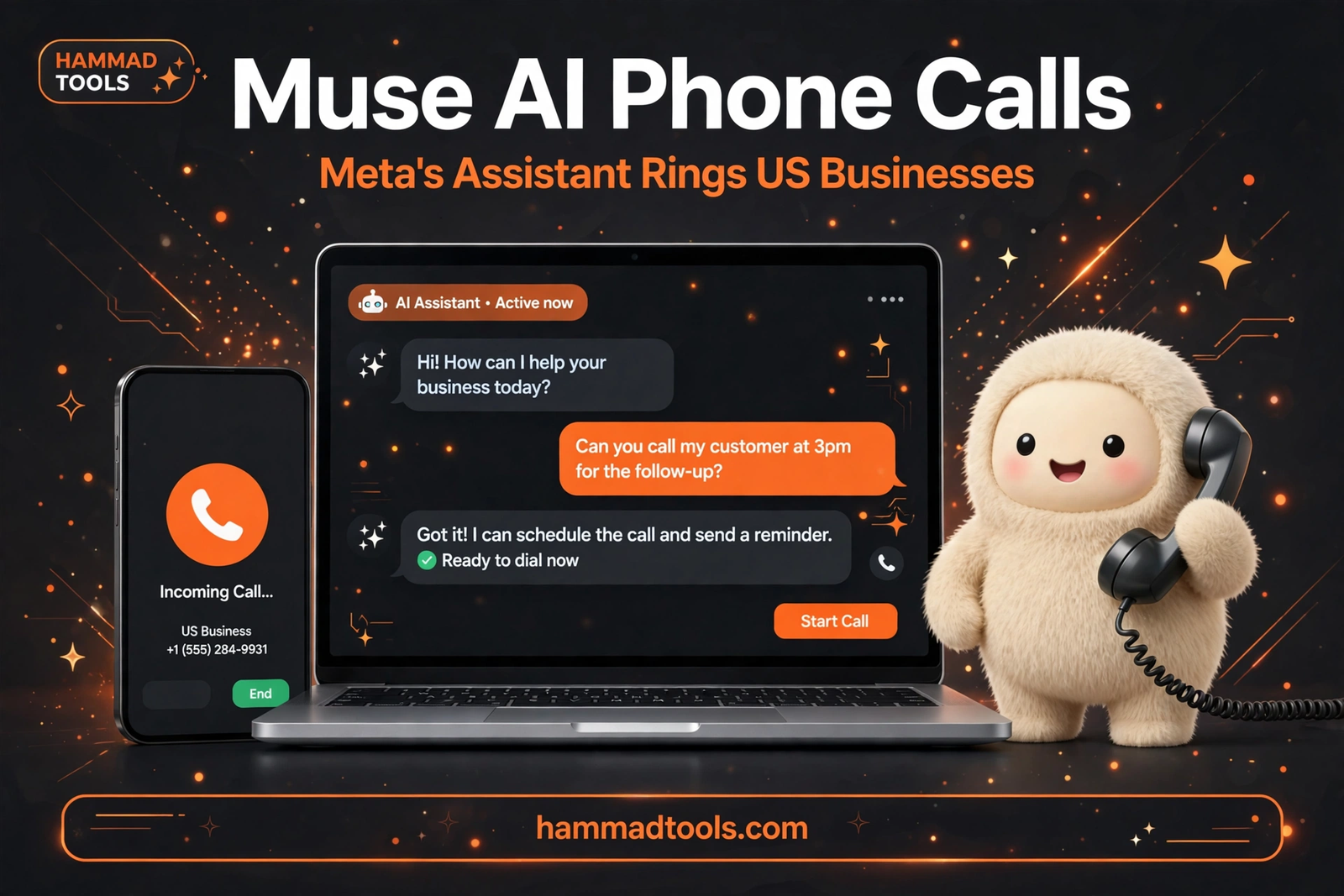
Muse, Meta's consumer AI agent, can now place phone calls to businesses in the United States on behalf of its users. The feature went live on 12 November 2026, announced by Meta's chief AI officer Alexandr Wang on X — and it is the clearest sign yet that the AI race is moving out of the chat window and into the chores nobody wants to do.
What Muse can now do on the phone
The idea is straightforward. You tell Muse what you need — a restaurant table on Friday, an appointment rescheduled, a question for your cable company — and Muse rings the business, talks to whoever picks up, and gets it done. It can wait on hold for as long as it takes, which is the part most people will appreciate first.
Wang's examples tell you who this is for: the cable company, the DMV, the restaurant that still does not take online reservations, the insurer — the calls people put off for weeks because making them is miserable.
This is not a first-day experiment: Meta tested it with a small group of early adopters from September. Two months was enough to open it up — and, according to Wang, the early results were already interesting. He said Muse had trimmed users' insurance costs during the trial and talked one cable bill down by $85 a month. A chatbot that haggles is a different proposition from a chatbot that chats.
Who gets it — and what it costs
For now, calling is paid-only and US-only. Anyone who pays for Muse can ask it to make calls; free users cannot, and neither can anyone outside the US. Meta has given no date for wider access.
Muse subscriptions start at $20 a month, which buys 500 million Muse tokens a week — tokens being the units AI models use to measure usage. Heavier users can pay $100 a month for 3 billion tokens. Like ChatGPT Plus, which we covered in ourChatGPT Plus price in Pakistan guide, the useful features increasingly sit behind the subscription, and calling is the latest one to join that list.
The new Muse email address, by contrast, will soon roll out to free users too, Wang said this week. Calls stay behind the paywall.
Muse is still young — Meta unveiled it in September — but it already has over 10 million users, the company said last month. An assistant that makes calls is a much stickier product than one that only answers questions.
The catch: some businesses hang up on AI callers
There is a problem on the other end of the line. Plenty of businesses hang up on AI agents the moment they realise they are not talking to a human — TechCrunch cited the reports directly: identify the caller as AI, and the call often ends there.
Part of it is trust: a receptionist burned by robocalls has no reason to believe the polite voice is a genuine customer. And as AI voices get better at mimicking real people, telling the difference will only get harder — which may make businesses more suspicious, not less.
So the real test is not whether Muse can dial a number, but whether the people answering get used to talking to it. Meta is betting usefulness wins: a caller with infinite patience and perfect recall is, in the end, an easy customer to deal with.
Muse is not the first to pick up the phone
Meta is not inventing this category. Google's Gemini can already place calls to businesses, and a startup called Instinct has been offering a similar service. The idea of an AI that handles phone chores has been around since Google first demonstrated Duplex back in 2018 — an assistant booking a haircut over the phone, to a mixture of amazement and unease.
What has changed is the timing. In 2018, a voice agent was a demo. In 2026 the models are good enough and the subscriptions are in place, and every lab is pushing the same message: AI should do things, not just say things. The same shift sits behindOpenAI's $10 billion quarter — agents that complete tasks are where the industry is heading, and the phone is one of the last places a computer could not reach.
Why Meta is betting on boring chores
The AI labs spent years competing on benchmarks — who writes better code, who scores higher on the tests. Muse's calling feature competes on something far less glamorous: who saves you twenty minutes on a Tuesday.
That is deliberate. An assistant that books your table, argues with your cable company and waits on hold for the DMV becomes part of your routine in a way a clever chatbot never does. Once it is handling your errands, switching to a rival means giving up a helper, not just changing an app.
It also explains the pricing: a $20 subscription is easier to justify when the assistant does visible, annoying work for you every week than when it answers questions you could have Googled.
What it means outside the US
For now, this is an American feature for American subscribers. Users in Pakistan and the UK cannot try it yet, and Meta has said nothing about when that changes — the usual pattern is the US first, then a slow expansion.
Still, the direction is clear. The assistants of 2026 answer questions; the ones of 2027 will increasingly make the calls, send the emails and chase the paperwork. Whether businesses learn to live with that — or keep hanging up — decides how fast it spreads.