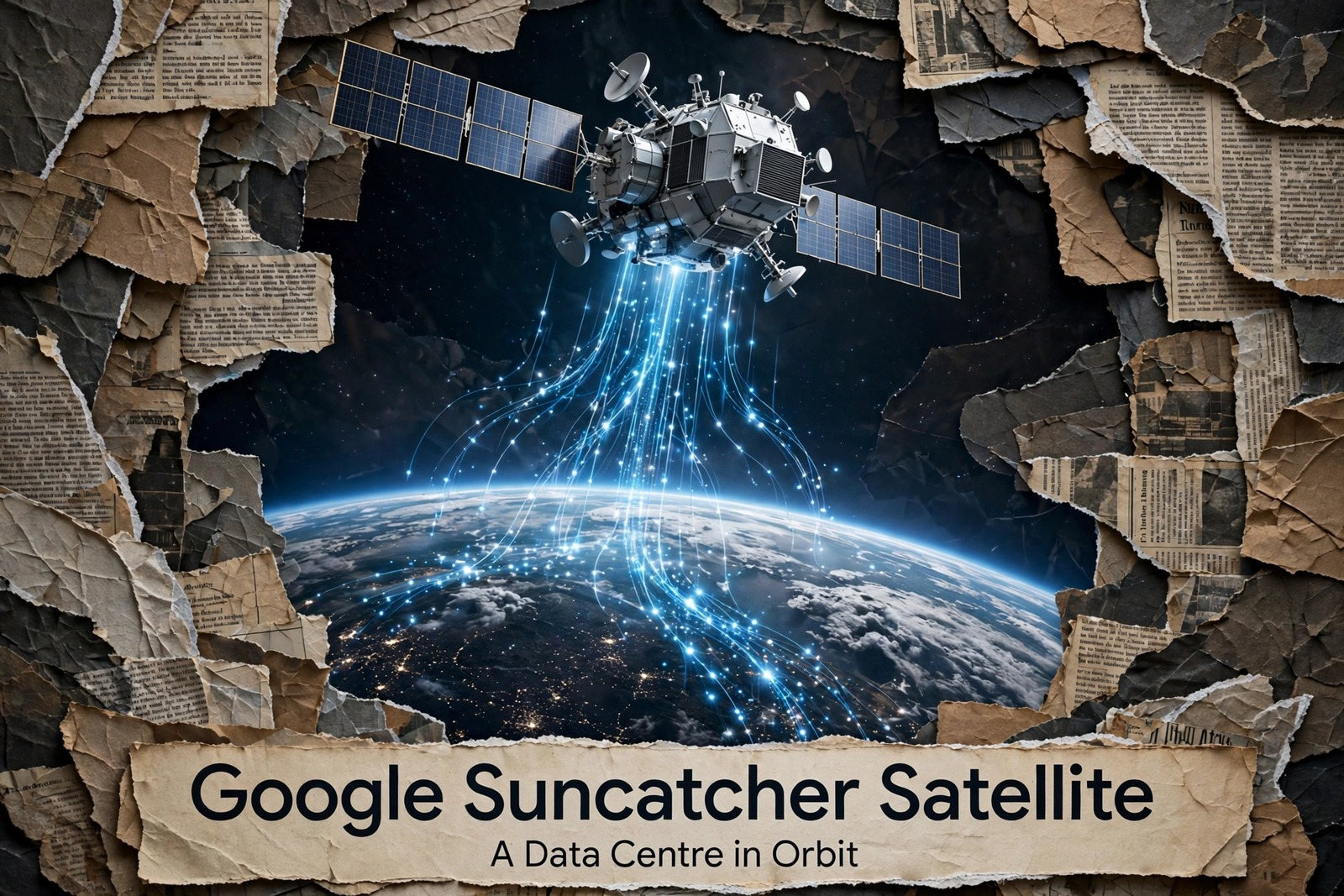
Google's Suncatcher prototype satellite is now online and talking to the ground, after launching earlier in October alongside more than 100 other spacecraft on a SpaceX Falcon 9 rocket. After about three weeks of checks on its systems, engineers sent it a first prompt. They asked the model already loaded on board, Google DeepMind's Gemma 4, to write a haiku about being in space. The satellite obliged:
Blue marble below / Data streams in silent grace / Starlight feeds my core.
A haiku is a small thing to ask of a machine in orbit. That is rather the point. The poem was not the experiment; it was proof that the experiment works.
What Suncatcher actually is
Google's test of an idea that sounds like science fiction: move some AI computing off the planet. The prototype carries four of Google's Tensor Processing Units, the custom chips it builds for AI work, and generates up to 1 kilowatt of electricity from its solar panels. Its long-term goal is a network of satellites flying close together, sharing large AI inference jobs — the work of running a trained model to answer questions, rather than training it.
That distinction matters. Training a model is the heavy, power-hungry phase. Inference is what happens every time someone actually uses an AI tool. If satellites can handle inference in orbit, they could one day take some load off ground data centres, using unfiltered sunlight for power and radiating waste heat straight into space instead of needing vast cooling systems on Earth.
The power problem, in one number: twenty minutes
The satellite's four TPUs come with a catch. Its power budget only lets it switch on one chip at a time, for about twenty minutes at a stretch. The rest of the time, the machine must wait, recharge, and prepare for the next pass.
That constraint shapes everything else. Talking to the ground is already fiddly for a fast-moving satellite with only short windows over a ground station; doing it while the computer itself runs only in short bursts makes it harder. A company spokesperson told TechCrunch the satellite was operating nominally — in space-industry language, everything behaving as expected so far.
Twenty minutes at a time will not run a cloud service. Nobody at Google is pretending otherwise. The question Suncatcher is designed to answer is whether the chips survive and perform well enough in space for a bigger, more powerful version to be worth building.
Radiation: the test you cannot fake on Earth
That is where the real experiment begins. Space radiation can flip individual bits in computer memory — a stored 1 becoming a 0, or the reverse — silently corrupting data without setting off the usual alarms. Google has already bombarded its TPUs with particles in accelerators on Earth, but a laboratory is not orbit. The ongoing test campaign will watch how the chips cope with real thermal stress and the real radiation environment, over time.
Ground testing suggested radiation would be a minor issue for inference work and a bigger problem for training, which is one reason Suncatcher is aimed at inference first. Now the team gets to check that expectation against reality rather than simulation. If the chips degrade, glitch, or need constant correction, the whole economics of orbital computing changes. If they hold up, one of the biggest technical objections to the idea weakens considerably.
This is the honest way to read the poetry stunt. The haiku shows the chain works end to end: prompt up, model runs, answer down. The months of radiation and heat data that follow will show whether it works reliably enough to matter.
What comes next: two more satellites, in 2027
If the prototype passes its tests, Google plans to launch two more satellites in 2027, fitted with more advanced chips. Those spacecraft are expected to generate more power and, crucially, to demonstrate optical links between satellites — laser connections that let them talk to each other at high speed.
That last detail is what sets Suncatcher apart from most rival visions. Google wants satellites that can work together on a single distributed job, not just run separate jobs in isolation. SpaceX is also expected to use laser links, but TechCrunch notes its satellites would orbit too far apart to share processing effectively. Other companies, such as Starcloud and Cowboy Space, expect to run inference loads on individual satellites. Google's bet is that a tightly linked constellation can act like one computer, spread across the sky.
The economics are the hardest part
The engineering is only half the story. Getting thousands of satellites into orbit, cheaply and repeatedly, depends on a rocket that does not yet exist in its finished form: SpaceX's Starship, the heavy-lift vehicle meant to be fully and rapidly reusable. In a peer-reviewed analysis published earlier in October, Suncatcher researchers estimated SpaceX would need to fly Starship 1,800 times to achieve the same learning-driven cost reductions it saw with earlier vehicles. Alphabet, Google's parent company, also holds a significant investment stake in SpaceX, which ties the two visions together.
Meanwhile, the ground-based cloud business that would pay for all this is under its own pressure. Amazon's $220 billion cloud bet shows how much money the big providers are pouring into data centres on Earth, and investors have begun asking whether those returns will arrive fast enough. Alphabet itself saw its stock fall sharply this week, after reporting that putting AI into search is weighing on advertising revenue growth. A moonshot aimed at the 2030s has to survive the market mood of the 2020s — and that mood, right now, is impatient.
For now, the satellite is up there, running in twenty-minute bursts, writing the occasional haiku about the blue marble below. The poetry is charming. The data behind it is the point — and it will decide whether data centres in space stay a moonshot, or become the next place the internet lives.