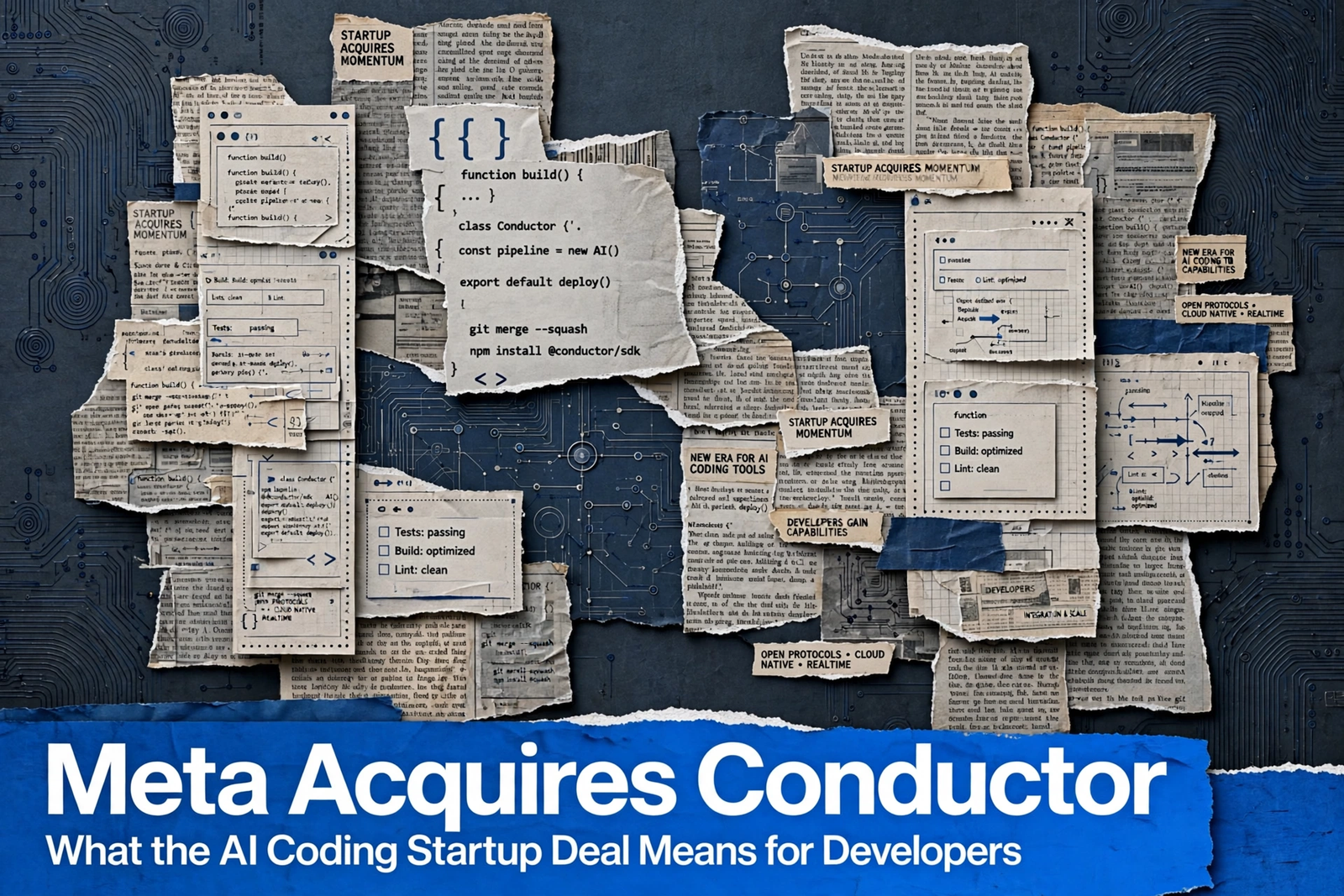
Meta has bought its way deeper into the AI coding race. The company has acquired Conductor, a startup that lets developers run teams of AI coding agents in parallel workspaces, in a deal first reported by Axios and confirmed by Meta to TechCrunch on 4 November. No price was disclosed, and Meta declined to comment further — but the shape of the deal, and what happens next, is already clear enough to read.
Conductor's founder and chief executive, Charlie Holtz, announced the move on the company's blog with a short, confident line: "Conductor is joining Meta." He added that the team has "big, crazy plans for the next interface" and teased "something new" for customers by early next year. On X, he said he was looking forward to working with Alexandr Wang, Meta's chief AI officer, and Nat Friedman, head of product at the company's Superintelligence Labs — adding that he believes Meta's Superintelligence Labs has "the highest talent density of all the labs".
That last line is the giveaway. This is not a quiet acqui-hire of a tool Meta plans to shelve. Holtz is talking about building the next interface, on a team he rates as the strongest in the field, while Meta confirmed the deal and said nothing more about the price.
What Conductor actually does
Conductor was founded in 2024 and only launched its core product last summer, so it is a young company even by AI startup standards. Its idea is simple to describe and hard to build well: instead of one AI coding assistant working on one task, Conductor spins up several agents at once, each in its own workspace, so a developer can work on separate, compartmentalised parts of a project in concert.
The agents can be deployed in the cloud, locally, or from a user's phone. That flexibility is part of the pitch — a team of agents that keeps working on different corners of a codebase while the developer moves between them, rather than a single chat window that handles one thing at a time.
One detail makes the deal more interesting than a routine talent grab. Conductor does not build its own agents — the ones its platform deploys come from major labs, Anthropic and OpenAI among them. Meta has just bought a product whose intelligence, until now, has been rented from its biggest rivals. What happens to those integrations under Meta is one of the first questions the deal raises, and neither side has answered it yet.
What changes on 20 November
For existing Conductor users, the deal comes with a hard date. Holtz said the product's core features will keep working as they have until early next year — with one exception. Conductor's cloud service shuts down on 20 November, after which the company will begin deleting user cloud data.
That is a short runway. Anyone running projects through Conductor's cloud has roughly two weeks from the announcement to move their work or accept the loss of that data. The local and phone deployments are not mentioned in the shutdown, which suggests the cloud is the part Meta does not want to keep running — but users should not assume anything until Conductor says so plainly. If your code lives in Conductor's cloud, export it now.
Why Meta wants it
Only a few months ago, Meta was widely described as lagging behind in AI services. The last several months have been a deliberate catch-up. In August, the company launched Muse Code, its own coding agent. Its recently launched Muse agents have, by Meta's own reporting, passed 10 million users. And the company has made a string of AI acquisitions over the past year, including Moltbook, the viral agent platform.
Conductor fits that pattern exactly: buy the team, buy the product, and buy speed. Coding is the one place where AI agents already do commercially useful work every day, which makes coding tools the most valuable beachhead in the agent race. OpenAI has been pushing in the same direction — its coding tools recently became OpenAI Dots, an always-on personal assistant — and every major lab now treats the developer's workflow as territory worth fighting over.
Meta's bet is that the winning coding product will not be a single assistant but a team of agents working in parallel — and that whoever builds the best version of that will set the terms for how software gets written. Conductor is small, young, and built on other people's models, but it is one of the few products actually running agent teams that way in production.
What to watch next
Three things will tell us whether this deal mattered. First, the "something new" Holtz promised for early next year — whether it arrives, and whether it looks like Conductor rebuilt inside Meta or something genuinely different. Second, what happens to Conductor's Anthropic and OpenAI integrations: if they quietly disappear, Meta is folding the product into its own stack; if they survive, Meta is buying a workflow, not just a team. Third, whether other labs answer with their own coding acquisitions, because the moment one big lab buys a parallel-agent coding startup, the rest start shopping.
The wider context is the same one driving the whole AI industry: valuations, talent, and infrastructure are all being argued about in public, a debate covered in our earlier piece on the Anthropic IPO 2026. In that climate, a deal like this is both a product decision and a signal — Meta intends to be a coding company, not just a social company with an AI lab attached.
For developers, the practical advice is simpler. If you use Conductor's cloud, move your work before 20 November. If you were considering it, wait and see what Meta builds with it. And if you write code for a living, watch who is buying whom — the tool you build software with next year may well be decided by a deal announced this week.