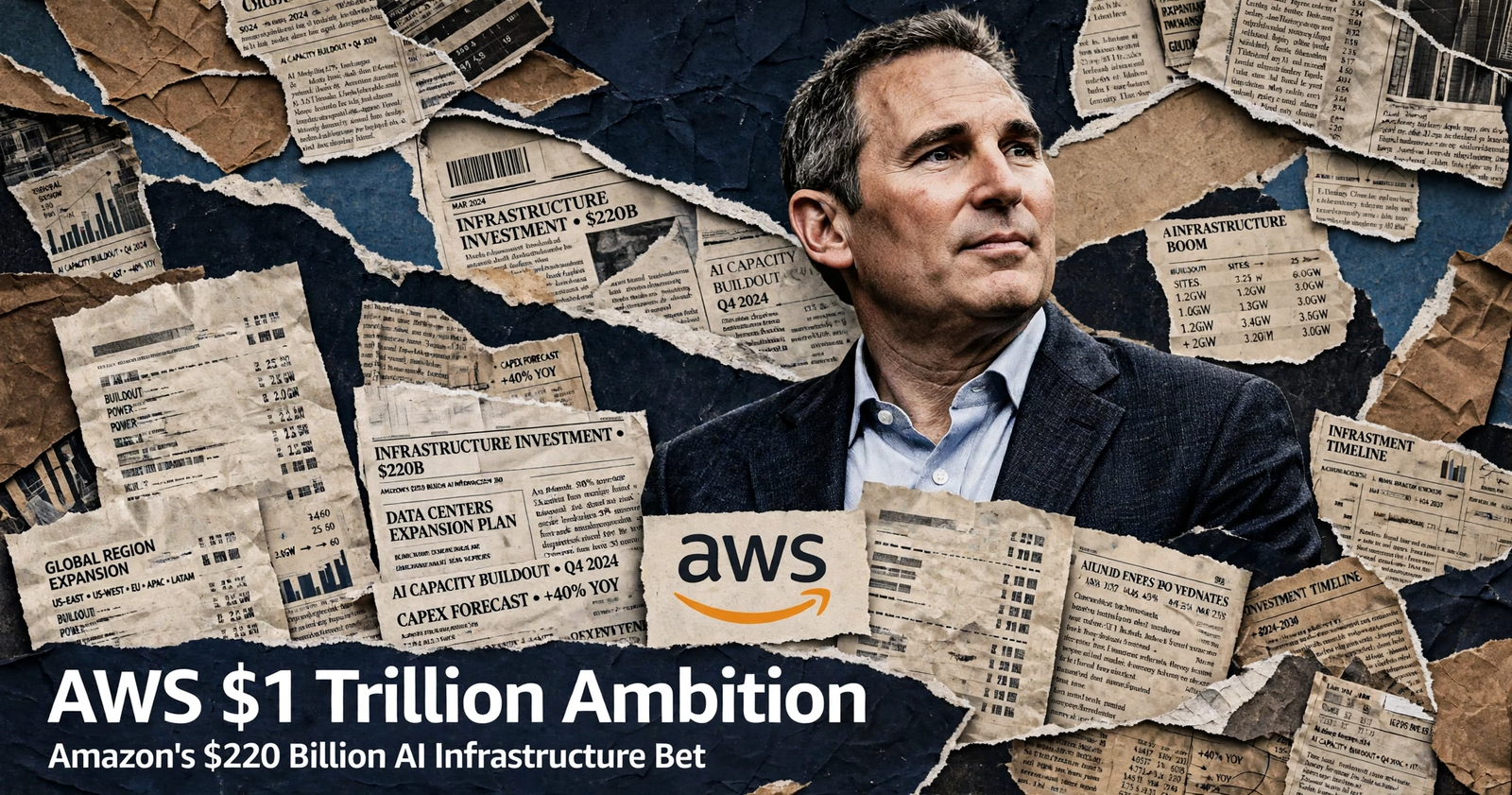
Speaking on Amazon's quarterly earnings call on Thursday 29 October 2026, Andy Jassy repeated his belief that AWS, the company's cloud division, can grow into a trillion-dollar annual revenue business. It was not a throwaway line. It came attached to a spending plan of a scale that even by big-tech standards stops you in your tracks, and to a growth forecast that stretches years into the future.
The claim deserves a closer look, because it sits at the centre of the biggest argument in technology right now: whether the enormous sums being poured into AI infrastructure will ever pay for themselves.
What Jassy actually said
Jassy's framing was deliberately grand. "What we're building at Amazon is unlike anything that's ever been seen before. There has never been a business with a trillion dollars of annual revenue," he told analysts on the call.
Then came the numbers that give the ambition its shape. AWS is currently a $184 billion annualised revenue run-rate business — that is, if its latest quarter's pace held for a full year, it would bring in $184 billion. Jassy forecast that AWS could grow by more than 40% in each of 2027 and 2028, and become a trillion-dollar revenue business within the next five to ten years.
The $220 billion bill comes first
Before any trillion-dollar future arrives, Amazon has to build it. Jassy told analysts that Amazon still expects about $220 billion in cash capital expenditure in 2026, with the majority going to AWS, and expects to spend meaningfully more in 2027.
Capital expenditure, in plain terms, is money spent on things that last: data centres, servers, chips, power and cooling. It is not a marketing budget or a hiring round. Once a data centre is built, it has to be filled with paying work, or it becomes a very expensive empty building.
Jassy argued the spending is justified because enterprise adoption of AI is still in its very early days, saying Amazon would keep investing to stay the leader and could fund the plan, which he said would permanently change Amazon's size and revenue. He called the AI boom a once-in-a-lifetime opportunity that required, and was worth, a big financial commitment now.
Why investors flinched
The market's first reaction was not celebration. Amazon shares fell about 6% in after-market trading on Thursday, according to TechCrunch's report.
That reaction tells its own story. Investors are not doubting that cloud demand is growing. AWS revenue rose 39% from the same quarter a year earlier, its sixth straight quarter of steady growth by that measure. What worries them is the gap between spending today and returns tomorrow, and whether the returns will be as profitable as the cloud business has historically been.
This is the same tension running through the whole AI industry. Every major cloud provider is spending heavily and earning heavily at the same time. Microsoft, for instance, has just posted yet more record-breaking revenue growth driven largely by its cloud business, while also spending a bundle on infrastructure. The pattern is consistent: the AI services that dominate headlines run on cloud infrastructure, and that infrastructure is neither cheap nor quick to build.
How AWS compares right now
AWS remains the largest cloud provider, and its growth rate is part of why the trillion-dollar claim is taken seriously rather than dismissed. A 39% year-on-year rise, sustained over six quarters, is not a one-off spike. It suggests businesses are genuinely moving more of their core work — and now their AI work — onto AWS, rather than merely experimenting with it.
Microsoft disclosed this week that Azure brought in $33.2 billion in a single quarter, its first-ever dollar disclosure, while Google Cloud reported $30.7 billion. AWS, at a $184 billion run rate, is still ahead of both on an annualised basis. Whether that lead holds depends on enterprise AI adoption keeping accelerating rather than plateauing once the easy use cases are covered.
What a trillion dollars would actually require
It is worth pausing on what a trillion-dollar AWS would mean, because the figure is so large it risks sounding abstract. A business of that size would be bigger than most countries' entire economies, and several times larger than AWS is today. Reaching it in five to ten years would require not just continued growth, but growth at a pace few businesses of this size have ever sustained.
Three things would all have to go right: AI workloads keep expanding into everyday business systems, AWS keeps winning a large share against Microsoft and Google, and the profit justifies the hundreds of billions spent building capacity. Miss any one, and the timeline stretches — or breaks. The claim should therefore be read as a statement of intent and a justification for spending, not a guaranteed forecast.
Why it matters beyond Amazon
For readers who never buy a cloud service directly, this still matters, because cloud spending is where the AI economy becomes concrete. Chatbots, coding assistants, image generators and AI agents all run on rented computing power. When Amazon commits $220 billion in a single year, mostly to AWS, it is effectively betting that the demand for that computing power will keep growing for years — and building the physical capacity to meet it.
More data centres mean more room for new services, but also higher fixed costs that providers must recover — a balance that will influence prices, performance and access for everyone downstream. The honest summary: the growth so far supports the ambition, and the spending required to sustain it is what makes investors nervous. The next few years of earnings reports will show which reaction was right.