
OpenAI Revenue Hits $10 Billion in a Quarter for the First Time
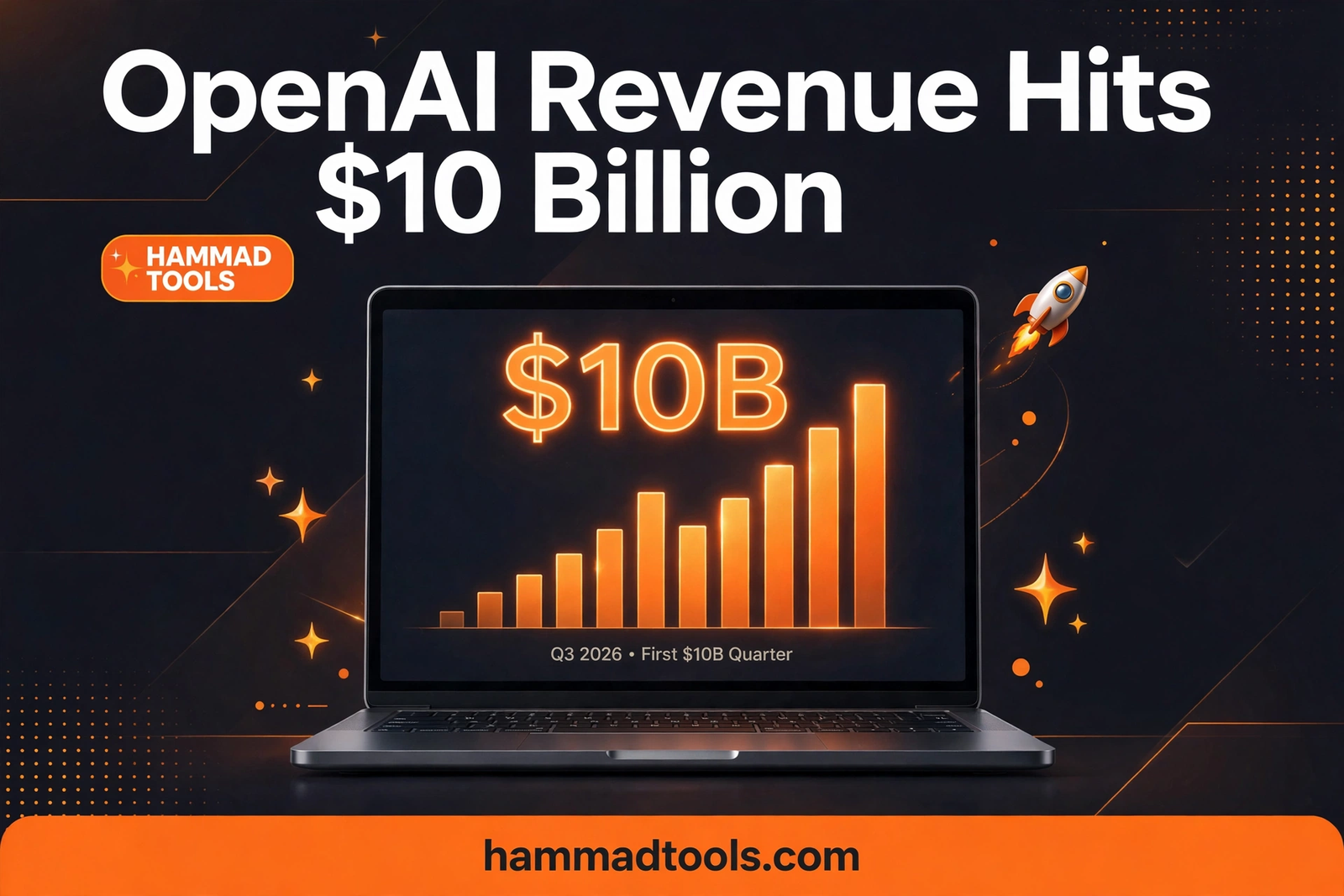
OpenAI just crossed a line no AI company has crossed before. In the three months to September 2026, the company behind ChatGPT reportedly brought in more than $10 billion of revenue in a single quarter — the first time it has ever done so, and a jump of almost 50% on the quarter before.
The figures were shared with investors on a call on Tuesday 10 November and first reported by The Information, The Wall Street Journal and Bloomberg. OpenAI's chief financial officer, Sarah Friar, called it a "blockbuster quarter". OpenAI itself has not publicly confirmed the numbers — as a private company it publishes no audited quarterly accounts — so what we have is reporting of what investors were told, not a filing. Even with that caveat, the direction of travel is hard to argue with.
From $5.7 billion to $10 billion in six months
The speed of the climb is the real story. OpenAI posted $5.7 billion of revenue in the first quarter of 2026 and $6.7 billion in the second — growth of about 18% between the two. Then the third quarter added roughly $3.3 billion in a single step, a near-50% jump that also put revenue at almost three times the level of a year earlier.
Put another way, OpenAI added in ninety days about as much quarterly revenue as many software companies earn in a year. At the current pace, Bloomberg puts the company's annual revenue run rate at roughly $50 billion. A run rate is not the same as money already banked over a full year — it is the latest quarter's pace stretched out — but it is still the clearest sign yet that the AI business has moved from promise to serious scale.
Businesses, not just subscribers, are driving it
The growth is not only coming from people paying for ChatGPT. Enterprise revenue doubled quarter over quarter, Friar told CNBC, and revenue is now split roughly equally between the enterprise business and consumers. That matters, because it means OpenAI is no longer leaning on one kind of customer.
ChatGPT now reaches 1.2 billion people a week. Behind that headline number sits a widening set of paid products: business plans, developer tools, coding agents and the commerce features OpenAI has been rolling out inside ChatGPT. The company has spent 2026 pushing beyond the chatbot into services that companies pay for by the seat and by the task — and the third-quarter numbers suggest that push is working.
The other half of the ledger: a $10.9 billion loss
Here is the part that keeps the story honest. OpenAI is making money faster than ever, and it is still losing money faster than ever. Its operating loss widened to $10.9 billion in the quarter, up from $10.1 billion in the previous three months, according to financial documents seen by The Wall Street Journal.
The one encouraging detail inside the loss is the margin. OpenAI's adjusted operating margin improved from -150% in the second quarter to -109% in the third. In plain terms, the company is still spending more than a dollar for every dollar it earns, but the gap is narrowing. Revenue is growing faster than costs for the first time in a while — which is exactly what investors needed to see.
Why is the bill so large? Training frontier models and running them for hundreds of millions of users takes enormous computing power, and OpenAI has been signing huge data-centre and chip deals to secure it. The company has also been hiring aggressively and expanding into new product lines. Growth at this pace is expensive by design.
What it means for everyone else
For the wider AI market, the numbers cut two ways. On one hand, they are the strongest evidence yet that people and businesses will pay real money for AI — not just try it free. That is good news for every AI company trying to build a business rather than a demo.
On the other hand, the $10.9 billion quarterly loss shows how brutal the economics still are. OpenAI can afford to lose that much because it can raise money at a scale nobody else can — days before these figures emerged, reports said it had raised $11 billion at a $1.25 trillion valuation. Smaller labs do not have that cushion, and the gap between OpenAI and the rest of the field may keep widening.
There is also a question the numbers do not answer: how much of this growth is durable, and how much is a one-off surge from new products and enterprise deals landing at once? The next quarter will tell us whether 50% growth was a step change or a spike.
The bottom line
OpenAI's first $10 billion quarter is a genuine milestone — the fastest revenue growth the AI industry has ever seen from its biggest name, driven as much by businesses as by consumers. But the $10.9 billion loss sitting next to it is the other half of the story. The company has proved it can sell AI at scale. The next test is whether it can do so at a profit — and whether anyone else can keep up while it tries.
Related reading on Hammad Tools:
- ChatGPT Plus price in Pakistan 2026 — https://hammadtools.com/blogs/chatgpt-plus-price-in-pakistan-2026
- OpenAI's cyber model finds 948 Linux kernel exploits — https://hammadtools.com/blogs/openai-cyber-model-finds-948-linux-kernel-exploits
- Anthropic IPO 2026: AI bubble or real growth? — https://hammadtools.com/blogs/anthropic-ipo-2026-ai-bubble-or-real-growth