
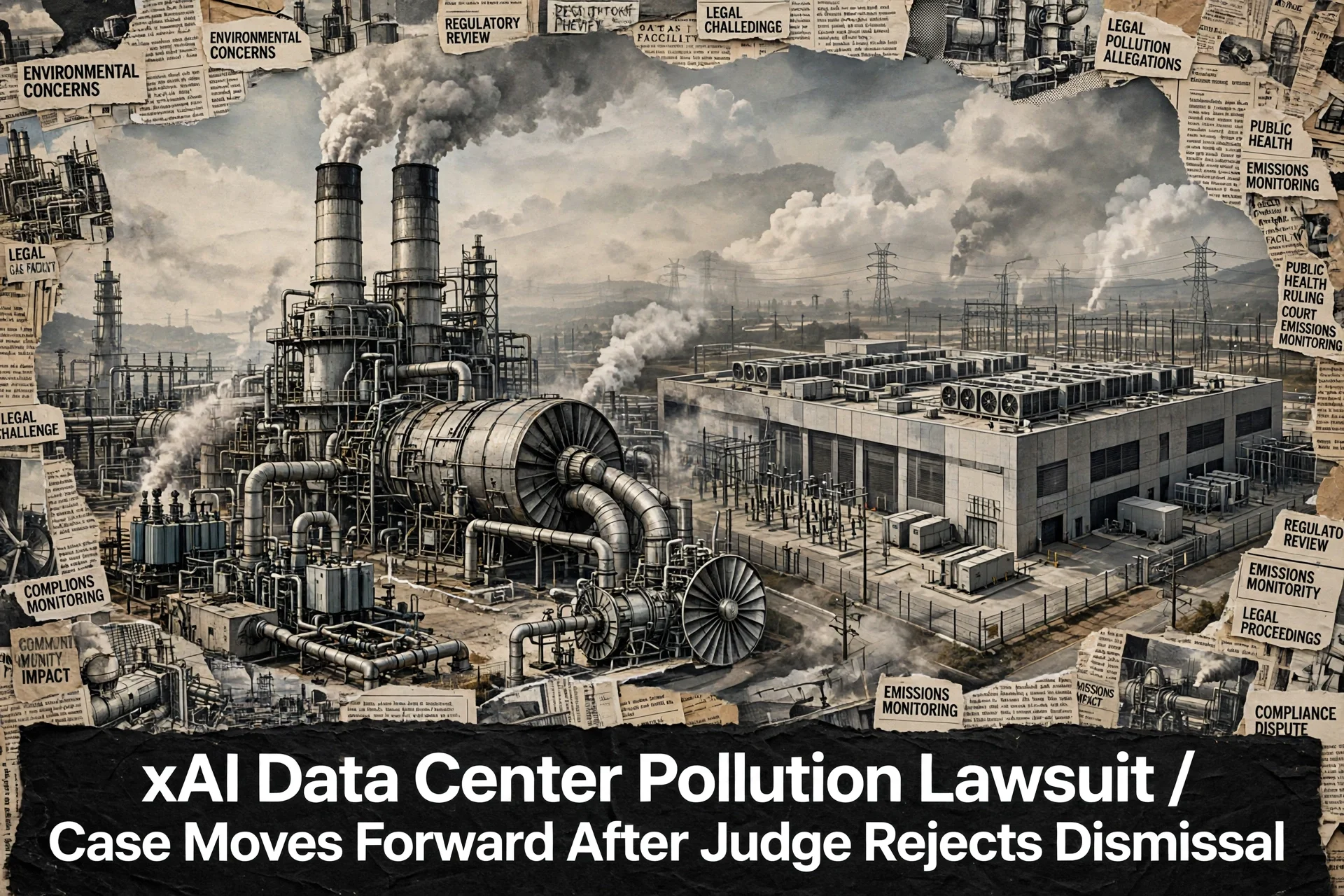
A federal judge has refused to throw out a lawsuit accusing xAI of running gas turbines at its Colossus data centre outside Memphis without the air permits the law requires. The ruling does not decide whether xAI broke the law. It decides something narrower, and still important: the case will be heard.
Brought on behalf of the NAACP by the Southern Environmental Law Center, the lawsuit says xAI installed and operated at least 35 combustion turbines and other air-pollution sources at Colossus without ever obtaining the necessary preconstruction or operating air permits, in violation of the Clean Air Act. xAI asked the court to dismiss the case. Judge Debra M. Brown said no.
For people living near a fast-growing data centre, that distinction matters. A dismissal would have ended the challenge before the evidence was tested. A ruling that the claims will proceed means the permits question — did xAI need them, and did it have them — now gets argued in court.
What the judge actually decided
Judge Brown dealt with three arguments from xAI, and rejected each.
First, standing. xAI argued that the plaintiffs did not have the standing to sue. The judge found they did, because they have statutory standing under the Clean Air Act: the law itself gives citizens a route to court when they say its rules have been broken, without waiting for a regulator to act first.
Second, the turbines. xAI claimed they were exempt from permitting because they are mobile. Judge Brown held that they are not "mobile sources" under Mississippi's State Implementation Plan, the state plan setting out how clean-air rules apply locally. That cuts to the heart of the defence: if the turbines are not mobile sources, the exemption does not save it.
Third, the constitution. xAI argued that the citizen-suit provision was unconstitutional, and that it violated the private nondelegation doctrine — the idea that private parties cannot be handed the government's enforcement power. The judge disagreed, writing that because citizen-suit plaintiffs sue on their own behalf and seek penalties redressing harm to themselves, they are not exercising the federal government's executive power.
Her summary was blunt: the plaintiffs have standing, the turbines are not "mobile sources" under Mississippi's plan, and the citizen-suit provision does not violate the Constitution — so "the plaintiffs' claims will proceed."
The turbines at the centre of the case
Colossus is xAI's data centre outside Memphis, and the turbines are not a side detail. Training and running large AI models needs enormous amounts of electricity, and gas turbines can fill a power gap quickly while grid connections catch up. They also burn fuel and emit air pollutants, which is why permit systems exist: a preconstruction permit checks a project before it is built, and an operating permit sets ongoing conditions once it runs.
The lawsuit's claim is therefore simple, even if the law around it is technical. It is not that turbines can never be used. It is that these turbines, the plaintiffs say, were installed and operated without the permits that should have governed them. xAI's answer so far has been about classification and procedure, rather than a public showing of permits, and the judge's ruling does not accept those procedural answers, at least at this stage.
Not the first dismissal attempt to fail
This is not the first dismissal bid to fail: a similar motion from the Department of Justice was denied earlier in October, according to the Southern Environmental Law Center.
Abre' Connor, the NAACP's director of environmental and climate justice, called the ruling "another important victory in our effort to hold xAI accountable," adding: "The courts have repeatedly rejected attempts by xAI and the DOJ to dismiss the NAACP's Clean Air Act case, affirming our right to pursue justice for communities impacted by pollution. Our position has been clear: xAI cannot operate gas turbines without the required permits."
For the campaigners, the case is not only about one site's paperwork, but about whether nearby communities get a say — and a legal remedy — when pollution rules are believed to have been skipped.
Why this case matters beyond Memphis
The ruling lands at a moment when public opinion about data centres appears to be turning. TechCrunch notes that New York recently passed a moratorium on new data centres, and that other state and local governments are considering similar measures. The backlash has already changed corporate behaviour: Amazon and Microsoft have promised to stop using non-disclosure agreements in their dealings with government agencies, a practice critics said kept data-centre deals hidden from the public.
That context explains why a procedural ruling in Mississippi is being read nationally. The AI build-out is no longer just a story about chips and models. It is also about land, electricity and air — and about who bears the costs when a facility the size of a small power station arrives in a neighbourhood. Amazon's $220 billion cloud bet shows the scale of spending flowing into AI infrastructure; the xAI case shows the other side of that spending, when residents ask what was permitted and what was emitted. TechCrunch also notes the backlash could be a factor in the imminent US midterm elections.
What happens next
The honest answer is that the hard part is still ahead. The plaintiffs still have to prove their claims, and a court will still have to decide, on the evidence, whether permits were required and whether they were obtained. A ruling that a case can proceed is not a finding of liability, and it would be wrong to present it as one.
What has changed is the balance of the argument. xAI can no longer end the case on those three grounds, at least not before this judge, on this motion. It will have to engage with the substance: the turbines, the permits, and the air.
There is a broader lesson too. The companies building the largest models are now also building some of the largest energy loads in the world, and permits, disclosure and local consent are becoming part of the story, not an afterthought. Colossus will be an early test of whether the courts agree.